|
What is it about a coin which gives it the designation of “finework”€�?
Many are familiar with the terms hammered and milled coinage which describe the way the coin was made. But what makes a coin a finework example? Can any coin type have finework examples or is the term used for another reason? Is the term used for another class of coin altogether and how does one recognise these pieces?
All good questions, requiring answers.
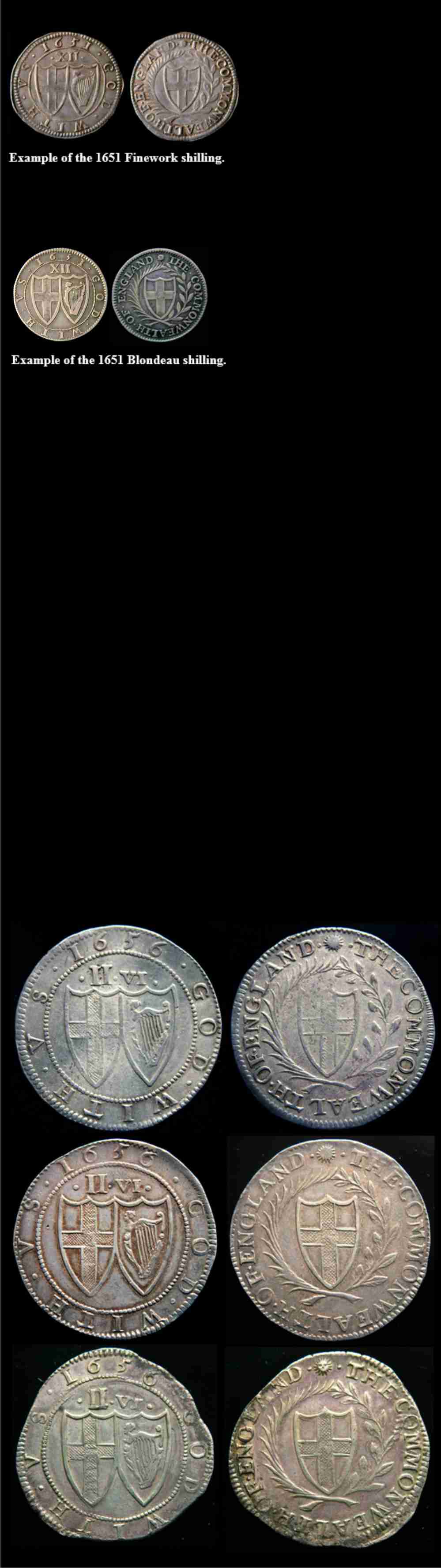
In the Commonwealth Period perhaps the best known example of a finework piece is the 1651 shilling shown. The first point to notice is the obvious quality of the coin, beautifully struck with full detail, but there are other points -
Notice the extra fine beading on the reverse side. The correctness of every detail from the 7 strings on the harp, to the cross hatching on the shields, to all stops being present, no corrected errors and when viewed from the correct angle a polished surface to the fields is clearly seen. All these points suggest the dies were specially made and used in the first instance to make some quality coins. One could surmise that this was done to show what was possible with the hammer technique although obviously this was far from typical production.
The threat of the milling technique being adapted was present at the mint.
The Blondeau milling dies were of a distinctly different design and size, being smaller in diameter to produce a thicker flan to the finished coin for the same weight of silver. Also no stops at the value or at the mintmark, a Symonds style digit 5, a much finer cross hatch to the shields, 10 strings to the harp and a finer inner beading, all suggesting that Blondeau went all out to prove just how superior his process was.
There was however one common starting point which limited the numbers of coins that could be made and that was the silver blank. This had to be round, correct weight and with a surface flatness higher than normally seen and sized differently for the two techniques so all the detail on the dies could be captured on the coin without excessive force being used.
There are accounts that Blondeau had around 100 blanks to use. The number of finework pieces in existence suggest that very few were made, maybe less than 10. The finework dies were then distributed into normal production of the 1651 shilling. So one can find a finework reverse die coupled with a regular production obverse die.
This is the first example I know of for a finework piece in the Commonwealth Period.
So key features for finework examples are -
* Hammered technique used to make the coin
* No errors or omissions to the features on the die
* Correct weight, usually within 0.2 grammes of target weight
* A very round flan
* An unusually flat flan with an often polished appearance in the fields
Essentially these coins are the closest the hammered technique could come to the milled technique.
Other dates to look out for -
1656, halfcrown and shilling, another year when the mill came to the forefront.
Why 1656? That was year some 1656 Cromwell Halfcrowns were made using Blondeau’s mill. One could expect some high quality blanks might have found their way to be used with the hammer using fresh dies for comparison.
The 1656 halfcrown is an interesting piece as there appear to be potential variants, as if the mint was trying to make a decision on design features. The top coin shown is the coin regarded as finework by major dealers. However there appears to be a variant as if a decision was being made on reverse design. Notice the obverse is of similar style with the fine 18 reed structure. It’s on the reverse where there are large and small sixes where we have the most obvious difference.
Small sixes are associated with pre-1654 reverse designs. In 1654 large sixes were introduced. That suggests the top coin was produced first. The middle coin also appears to be of a finework standard but produced a short time later. The obverse on both these coins is different and they have design features suggesting a similar time of production to the reverse.
The bottom image is of a coin from regular production for a comparison of quality. The dies in use could be the same as those used in the middle image. The difference is the blank used to make the coin. The coin shape suggests that the coin was struck using an irregular shaped blank with three hits of the hammer.
So the limiting factor to numbers appears to have been the availability of high quality blanks. Using those blanks, high quality coinage was possible with both the hammer and the mill.
|